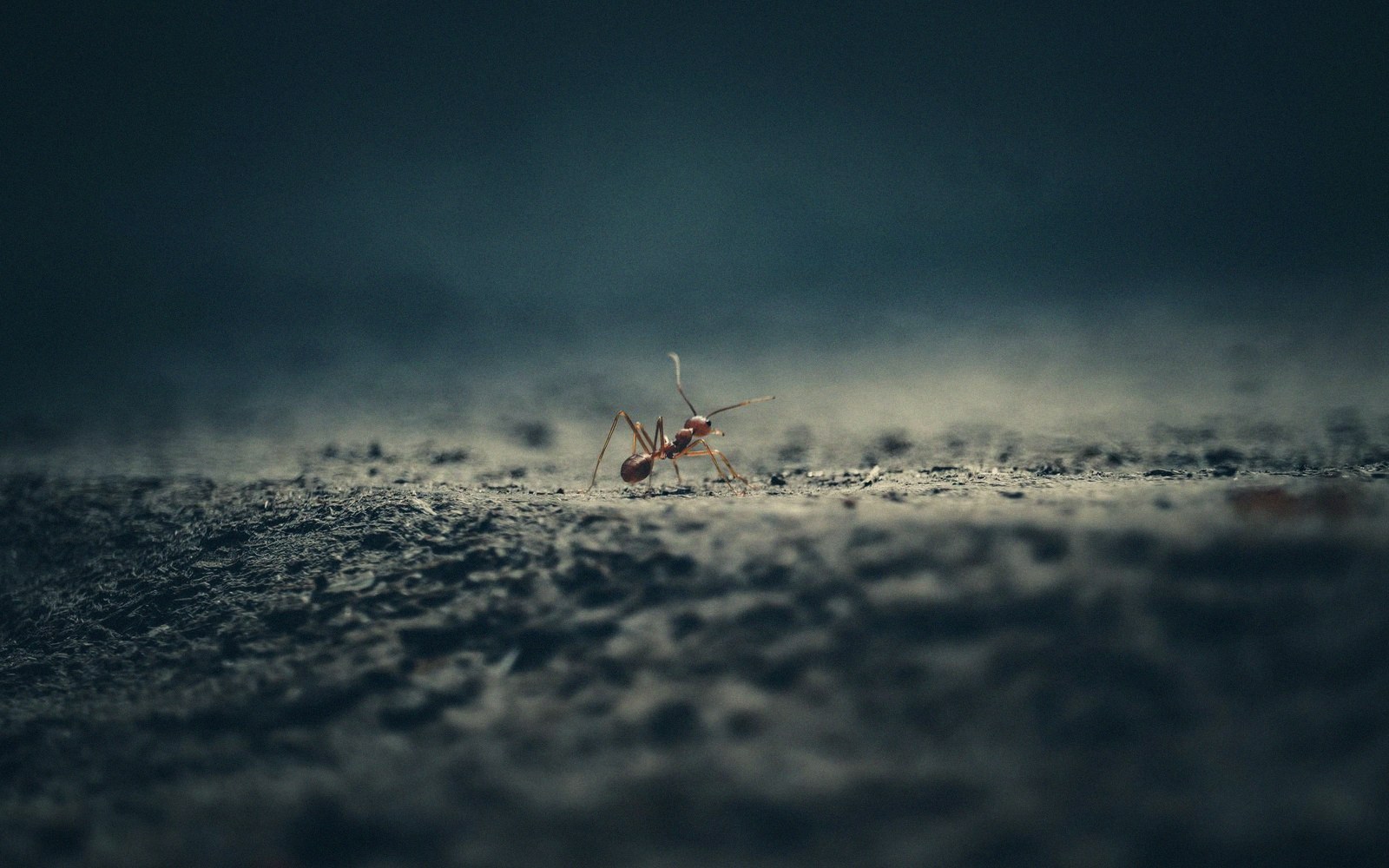
Them! opened in June 1954 and was Warner Bros.' highest-grossing picture of the year. That fact is worth sitting with for a moment, because by the standards of the creature cycle it spawned, the film is extraordinarily parsimonious with its monster. The queen ants don't appear until the third act. The opening twenty minutes are essentially a procedural — a sheriff, a little girl in catatonic shock, a trail of wreckage across the New Mexico desert — and the ants are present only as evidence: a shattered trailer, the ghost-sweet smell of formic acid, a sound design of high, grinding stridulation that arrives before any image does. Gordon Douglas directed it. He had made serials, westerns, a couple of Bowery Boys pictures. Nothing in his filmography suggested he was the man to set the template for a decade of American cinema. But he understood, or stumbled onto, the one thing his imitators would persistently fail to grasp: withholding is the mechanism, not the payoff.
The film's premise is straightforward in retrospect, though it arrived when the premise was genuinely new. Above-ground nuclear testing at Trinity and subsequently at the Nevada Proving Ground had released radiation into the Southwestern desert. The colony of Camponotus ants living in the blast zone had been irradiated through successive generations, and the result — per the film's entomologist Dr. Harold Medford, played by Edmund Gwenn with a testy, donnish authority that keeps the exposition from collapsing into lecture — is gigantism: ants eight to twelve feet long, possessed of formic acid powerful enough to dissolve a human torso. This is, of course, biologically nonsensical. Insects at that scale cannot breathe; their exoskeletal structure cannot support the mass; their tracheal system is wholly inadequate for oxygen exchange at anything approaching giant proportions. The film does not acknowledge this, but it does something cannier — it never asks you to think about it. The procedural pace and the semi-documentary texture keep the register close to realism long enough that when the creatures finally appear, you are already inside the film's logic.
The New Mexico sequences were shot partly on location and partly on Warner Bros.' own backlot, and the desert light gives them an authenticity that the later Los Angeles sewers — where the climax is staged — deliberately sacrifice for claustrophobia. That shift is structural. The film moves from open, sun-bleached distance (where you can see, and still miss things) to underground tunnels where scale becomes impossible to judge. The ants are enormous in either setting, but the sewers make enormity tactile in a way the desert can't: the concrete walls are a known size; a soldier pressed against one is a known size; and the creature filling the corridor behind him is therefore calibrated precisely, unavoidably. Douglas holds shots long enough for the arithmetic to work. His imitators mostly cut before the arithmetic could embarrass them.
Structural grammar of the film
Strip 1 / 2 · lifted from the reel
01
Withholding strategy — creatures present as sound and evidence before first image; this becomes genre template
02
Three-act geography — New Mexico desert / Washington D.C. briefing / Los Angeles sewers; each zone shifts the register
03
Lighting approach — ants lit from below or side, rarely in full static long shot; a workaround that became a grammar
What Restraint Actually Costs
The production budget was modest by major-studio standards but substantial for a science-fiction picture. The ant models — hydraulically operated, built by a crew under prop master Dick Smith — were expensive and, under certain lighting conditions and at certain angles, unconvincing. Douglas's solution was to hide the joins in the cutting and, crucially, to light the ants from below or from the side so that they read as mass rather than surface. You rarely get a clean, well-lit, static long shot of a complete ant at rest. The film earns this as artistry, but it began as damage control.
That pragmatic origin is important because it produced a grammar. Shot length, angle, intercutting with reaction — the tools Douglas used to compensate for limitations became the tools that generated tension. Every subsequent picture in the cycle had the choice of adopting that grammar as a discipline or simply pointing the camera at the thing and hoping the thing was impressive enough. Tarantula (1955) pointed the camera at the tarantula, and the tarantula is genuinely impressive on a mesa, but the film has nowhere to go once it has been seen because the grammar of tension was never established. It front-loads the spectacle and then has to keep producing spectacle to hold attention. Them! allocates spectacle as payoff, so each successive appearance of the ants carries the weight of everything withheld before it.
The other element that has aged better than the monster effects is the film's treatment of radiation as cause rather than as atmosphere. Dr. Medford and his daughter Dr. Patricia Medford — played by Joan Weldon, one of very few female scientists in the genre given unambiguous professional competence rather than decorative function — are not there to create a love interest and explain the plot between scenes of screaming. Patricia Medford identifies the colony, estimates the queen's likely trajectory, and is correct. Her father is allowed to be elderly, asthmatic, and occasionally frightened. Neither of them heroises the bomb. Medford's closing speech — warning that humanity has entered an atomic age whose consequences cannot be predicted — is measured, genuinely troubled, and notably free of the triumphalism that closes most of the pictures that followed. It is the only moment in the film where the filmmakers seem aware that the first atomic bomb had been detonated in that same New Mexico desert.
02
A projection lens, and the beam going out through the haze toward a screen you cannot see.Photo: Ann H / Pexels
The Template and Its Misreadings
Production and release context
Strip 2 / 2 · lifted from the reel
01
Release — May 1954, Warner Bros.; highest-grossing WB release of that year
02
Director — Gordon Douglas; prior credits in serials and westerns, no prior science-fiction
03
Effects method — hydraulically operated ant models; practical constraints shaped the editing grammar
04
Castle Bravo — March 1954 thermonuclear test at Bikini Atoll; contaminated Lucky Dragon No. 5 crew; released same year as the film
The pictures that followed Them! in 1955 and after treated it as a kit: a scientist, a military man, a woman with a professional credential, a creature of unusual size, a climax in a confined space. But the kit is not the film. The film is the discipline of delay, the procedural grounding, the ratio of absence to presence. The Beginning of the End (1957) gives you the grasshoppers in the first reel and spends the remaining hour watching them not be scary. The Black Scorpion (1957) — which has effects work by Willis O'Brien, whose craft was extraordinary — stages its climax in Aztec Stadium in Mexico City and then fumbles the geography so badly that the scale collapses. Even pictures with genuine ambition, like Jack Arnold's Tarantula, front-load the reveal and inherit the structural problem that produces.
The argument about displacement — that the creature feature externalised nuclear dread into a body the audience could watch, fight, and see destroyed — applies to Them! as well as to its successors, but with a crucial modification. Them! does not let the audience off cleanly. The ants are killed, but the mechanism that made them — above-ground testing, continued and accelerated in 1954, the year of Castle Bravo, the largest American thermonuclear test, which contaminated the crew of the Japanese fishing vessel Lucky Dragon No. 5 and triggered international alarm — is neither addressed nor resolved. Medford's speech gestures at it without containing it. The sewers are cleared; the sky above the Nevada Proving Ground is not. This irresolution, which reads as a structural flaw if you expect genre closure, is actually the thing that places Them! above its competition. The problem is not solved. It is merely not visible anymore.
That is almost certainly more than Douglas intended. But the films that have outlasted their moment are routinely smarter than their intentions, because the moment they were made in was smarter — and more frightened — than anyone involved could consciously admit. Them! arrived in the same year as Bikini Atoll's Castle Bravo test, the same year the AEC was licensing its test footage to productions that wanted authenticity without expense, and the same year that Gojira was made in Japan. It is not a great film in the sense that On the Beach makes a claim to being a great film — it is a genre picture, made quickly, with hydraulic ants and a third act in a storm drain. But as the originating grammar of a decade of American cinema, as the picture that established what mutation looks like when you keep it just off screen long enough, it has no peer.
The ants are convincing in the sewers. They are most convincing in the reel before you see them.