Frame 02 · The Supporting Programme · examined as evidence, not illustration
The Supporting Programme
Tarantula vs. The Spider: Which Reel It Dies In
A direct comparison of Universal's 1955 Tarantula and the 1958 Columbia picture The Spider, tracking the exact structural moment each film loses its nerve.
Two giant-arachnid pictures, one Universal, one Columbia — the craft gap is not where you expect it.
The First Film Holds Longer
Jack Arnold's Tarantula (Universal, 1955) earns its reputation for the first two-thirds by doing almost nothing. A dead scientist in the Arizona desert. A doctor asking quiet questions. Leo G. Carroll's nutrient-formula plot unspooling without hurry in a sun-bleached research station. Arnold understood that the desert already looked post-apocalyptic without a single frame of test footage, and he used its scale against the audience: the tarantula is introduced so gradually, so carefully intercut with ambient landscape shots, that its eventual size registers as genuinely wrong rather than just enormous.
The film holds its nerve through the middle reel in a way the giant-creature cycle rarely managed. Carroll's disfigurement — his face aged and distorted by the acromegaly compound he's been injecting — carries the actual horror. The spider is almost beside the point until it isn't. Arnold withholds the full-frame creature shot until the film has earned it, somewhere around the forty-minute mark, and the payoff lands because the groundwork is real.
Then reel six arrives. The military airstrike — napalm dropped by jets, the spider burning — is fine as spectacle but the film has already made its structural error two scenes earlier: the moment Mara Corday's Stephanie Clayton stops being a scientist and starts being someone who needs rescuing. She had been holding the film's intellectual thread. When she drops it, Tarantula drops it too. The argument about what unchecked growth-acceleration does to living tissue — the film's genuine subject — simply evaporates in favour of a clean military resolution. The spider burns. The Geiger-counter problem, in every sense, goes unasked.
Structural timeline
Strip 1 / 2 · lifted from the reel
01
Tarantula (1955, Universal, dir. Jack Arnold) — nerve lost at approx. reel six / 62-minute mark; military airstrike ending
02
The Spider (1958, American International Pictures, dir. Bert I. Gordon) — nerve lost at approx. reel three / 38-minute mark; cave-flooding ending
03
Gap between the two failure points: ~24 minutes — the piece's central argument
The Second Film Loses Its Nerve Earlier
Columbia's The Spider (1958), released under Bert I. Gordon's direction, starts from a disadvantage the film never overcomes: Gordon's rear-projection technique was visibly inadequate even by 1958 standards. Where Arnold's spider was shot with disciplined restraint partly because full-exposure would have broken the illusion, Gordon's creature is shown early, shown often, and shown badly. The spider turns up in a cave in the first act, and the transparency of the process work immediately turns menace into visual noise.
02
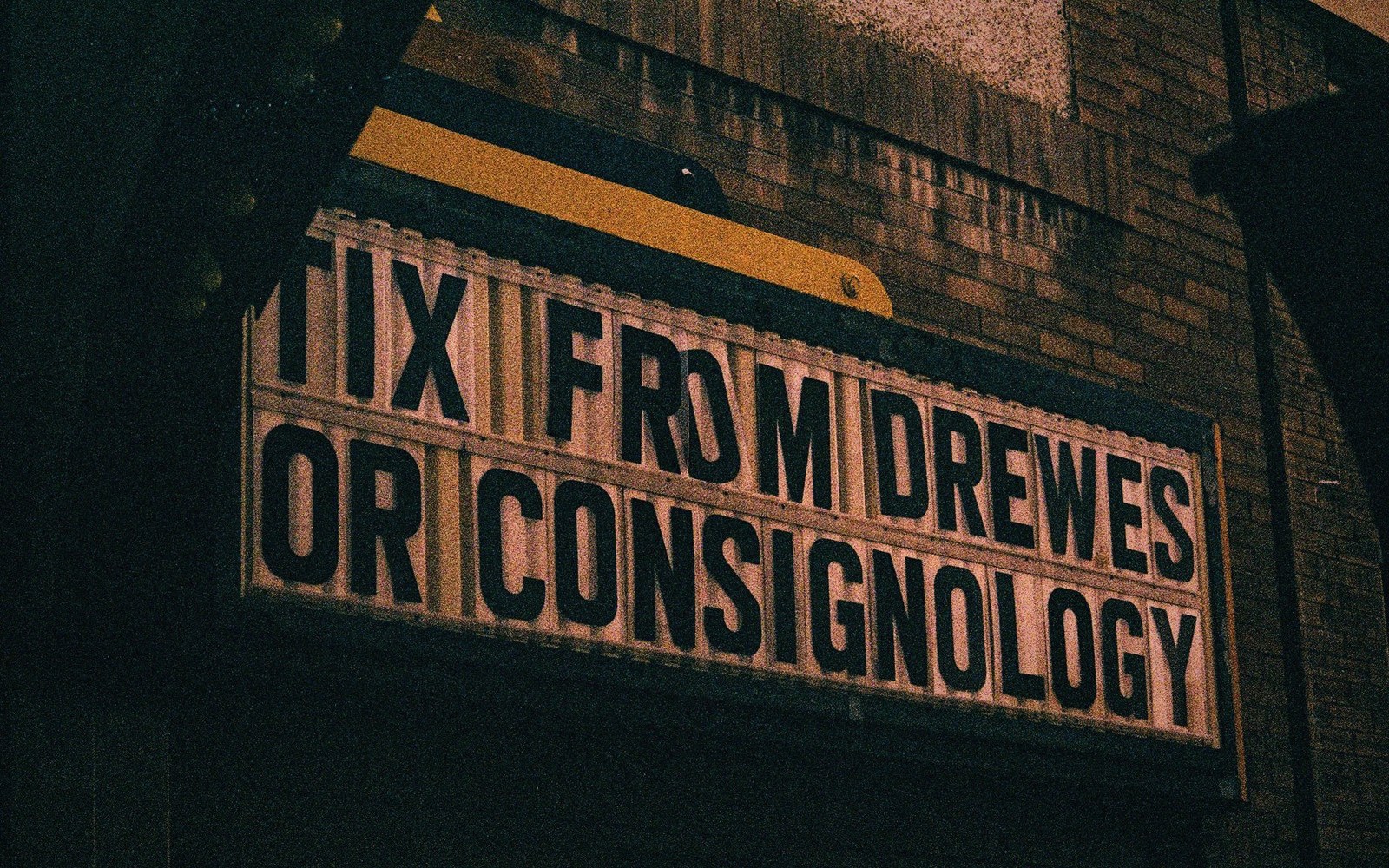
A lit letter-board at street level: the exhibitor’s half of the argument.Photo: David Guerrero / Pexels
Gordon's script attempts something structurally similar to Arnold's — scientists, a rural community, questions about what disturbed the creature — but collapses it in roughly the third reel. The film's pivot is the high-school dance scene, in which teenagers play loud rock and roll and inadvertently revive the spider, which the town believes dead. This is, in fairness, a reasonable idea: the creature waking to sound has a pleasing logic. What follows is not reasonable. The film abandons every institutional authority — sheriff, scientist, school faculty — and centres the resolution entirely on two teenagers, neither of them equipped by the script to carry the weight. The cave-flooding climax is rushed, cheap even by the standards of the supporting programme, and arrives before the film has asked a single question it finds genuinely interesting.
Key figures
Strip 2 / 2 · lifted from the reel
01
Jack Arnold — director, Tarantula; also directed The Incredible Shrinking Man (1957)
02
Bert I. Gordon — director, The Spider; known for low-budget giant-creature pictures of the late 1950s
03
Leo G. Carroll — plays the scientist Dr. Deemer in Tarantula; his physical disfigurement carries the film's horror
04
Mara Corday — plays Stephanie Clayton in Tarantula; the piece argues her character's collapse signals the film's structural failure
The Timing Gap
Tarantula loses its nerve at approximately the sixty-two-minute mark. The Spider loses its at approximately the thirty-eight. That twenty-four-minute gap represents the distance between a director who understood pacing as argument and one who understood it as schedule. Arnold's failure is a failure of resolution — he built something and then deferred to the formula at the last minute. Gordon's failure is a failure of accumulation: there is nothing to defer from, because the film never quite believed in itself long enough to establish what it was afraid of.
Both films end with the creature dead and the landscape restored. Neither earns that restoration. Tarantula at least makes you feel the loss of something. The Spider makes you check your watch.