Frame 03 · The Supporting Programme · examined as evidence, not illustration
The Supporting Programme
The Gill-Man as Containment Failure
Reads the Creature from the Black Lagoon (1954) not as a monster movie but as a containment-protocol film — the expedition's real error is scientific hubris, not navigation.
The expedition makes every wrong decision in the correct order
The scientists in Creature from the Black Lagoon (1954) do not stumble into the Black Lagoon by accident. They plan their way there. They file permits, pack equipment, and bring a woman whose white swimsuit will later glow against the dark water like a signal flare. What Universal's direction by Jack Arnold and the screenplay by Harry Essex and Arthur Ross actually constructs — beneath the rubber suit and the 3-D gimmick — is a rigorous procedural about how not to handle an unknown biological hazard. The expedition fails not because the Gill-Man is unstoppable, but because the team never once considers containment as a first principle.
The film's procedural logic
Strip 1 / 2 · lifted from the reel
01
Intrusion event — the expedition travels toward the unknown rather than establishing a controlled approach
02
Live-specimen attempt — the team's goal is capture, not observation; containment is incidental, never primary
03
Wakulla Springs — the Florida location used for underwater photography; the Gill-Man's ease of movement there is a formal argument
04
Mirror-swimming sequence — the extended shot of the creature tracking Kay Lawrence; ambiguity between curiosity and menace is deliberate
The framing device makes this explicit if you let it. The opening narration moves from the Big Bang to a fossilised hand discovered in an Amazonian clay bank, and the hand belongs to something that is still alive downstream. Dr. Carl Maia's response to this intelligence is to cable colleagues and arrange a boat, not to alert any authority or establish a quarantine perimeter. By the time the Rita enters the lagoon, the team has already committed the foundational error: they have gone toward the unknown object rather than waiting for the unknown object to come to them under controlled conditions. Every subsequent decision — the fish poison dumped into the water, the nets, the spear gun, the attempt to take a live specimen — compounds that original hubris.
Jack Arnold and his cinematographer William E. Snyder built the underwater sequences at Wakulla Springs in Florida, and the visual grammar of those sequences is worth pausing on. The Gill-Man moves through volumetric light-shafts with the ease of a resident, while the divers struggle and kick. The formal composition insists on the same argument the screenplay keeps making aloud: this is not the creature's failure to conform to the human world; it is the humans' failure to respect the boundaries of another system. The lagoon is a sealed environment. The expedition is, in contemporary biosafety language, an unplanned intrusion event.
02
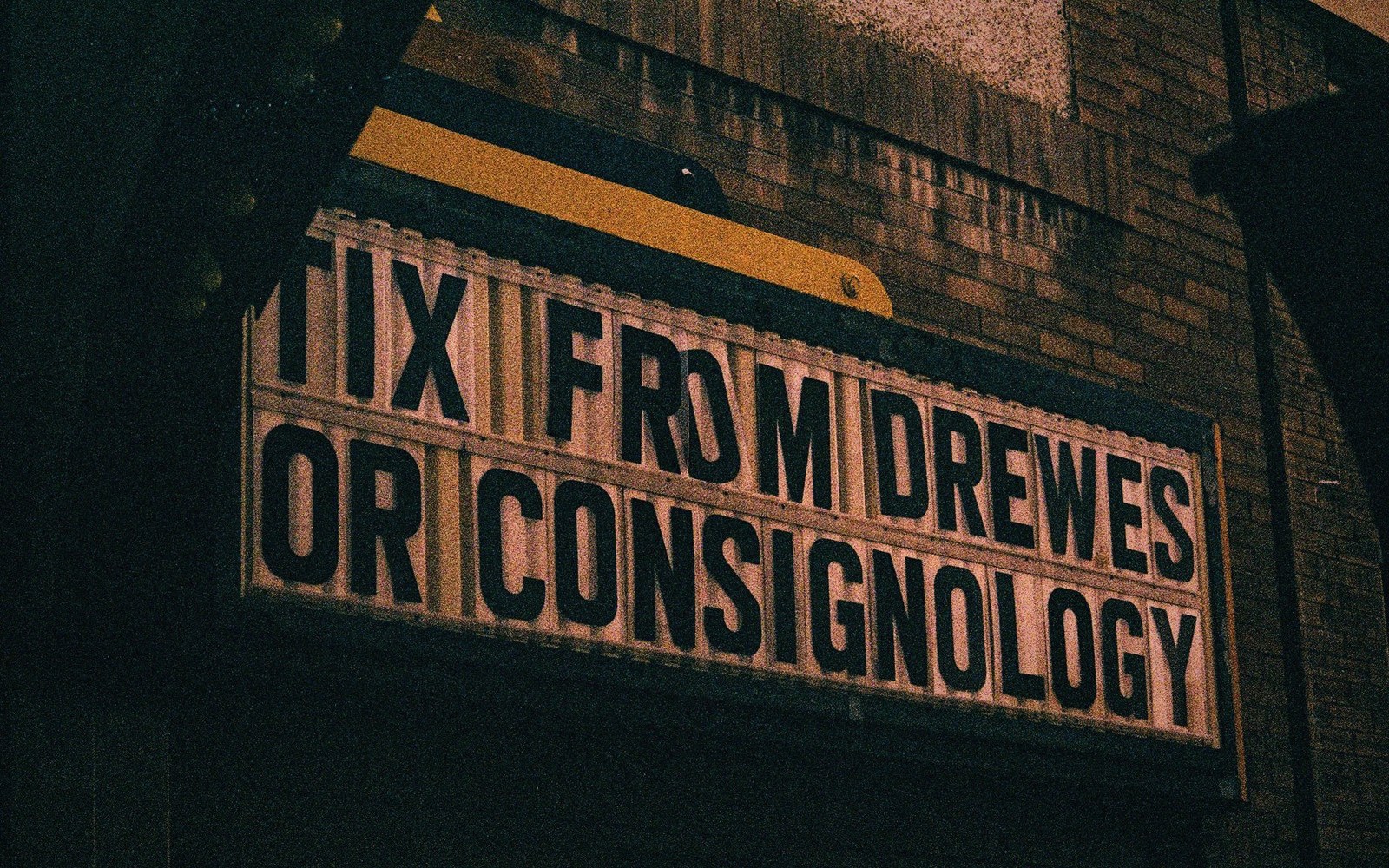
A lit letter-board at street level: the exhibitor’s half of the argument.Photo: David Guerrero / Pexels
What Universal was quoting, whether consciously or not, was the anxiety structure of the early atomic era's containment thinking. The AEC's own protocols, the classified site perimeters, the film badges and dosimetry records — all of it rested on the premise that certain things could be kept inside a boundary if you were disciplined enough. The Nevada Test Site had its restricted zones; the Black Lagoon has its geography. The expedition's hubris is precisely the hubris of a science that believed it could manage what it did not yet understand, simply by wanting to badly enough. That the Geiger counter as dramatic prop appears in so many films of the period as a reassurance device — it tells you the danger, therefore you can handle the danger — finds its inverted mirror here: the team has instruments and expertise, and they make everything worse.
Period parallel
Strip 2 / 2 · lifted from the reel
01
AEC restricted zones — the Nevada Test Site perimeters that embedded containment thinking into American public life by 1954
02
Film badges and dosimetry — period instrumentation that implied hazards could be managed if measured; inverted by the expedition's false confidence
The creature itself never quite becomes a villain in any satisfying sense. It defends, it retreats, it reappears. The moments that read as aggression are almost always responses to encroachment. Even the famous mirror-swimming sequence — the Gill-Man tracking Kay Lawrence (Julie Adams) from below, matching her strokes — is formally coded as curiosity before it is coded as menace. Arnold holds the shot long enough that the danger is ambiguous. The film needs you to feel that ambiguity, because without it the containment reading collapses back into simple monster territory.
By the final reel, the surviving scientists have lost specimens, lost colleagues, and damaged the ecosystem in ways the film declines to calculate. The Gill-Man is driven back into the lagoon, neither dead nor captured. The expedition retreats having learned nothing operable. As endings go, it is more honest than most of the cycle: containment was never achieved, because containment was never the team's actual goal. Discovery was. And discovery, in the atomic age, was rarely as clean as the funding proposal suggested.