Frame 14 · The Science They Got Wrong · examined as evidence, not illustration
The Science They Got Wrong
Mutation Is Not a Superpower
An explainer on what ionising radiation actually does to cellular replication, written strictly to illuminate the gap between that process and the Hollywood version — not a science lecture but a before-and-after comparison using specific film scenes as the 'after'..
Hollywood's irradiated protagonists grow, shrink, or become magnificent. Actual radiation biology goes somewhere else entirely.
The Wrong Kind of Change
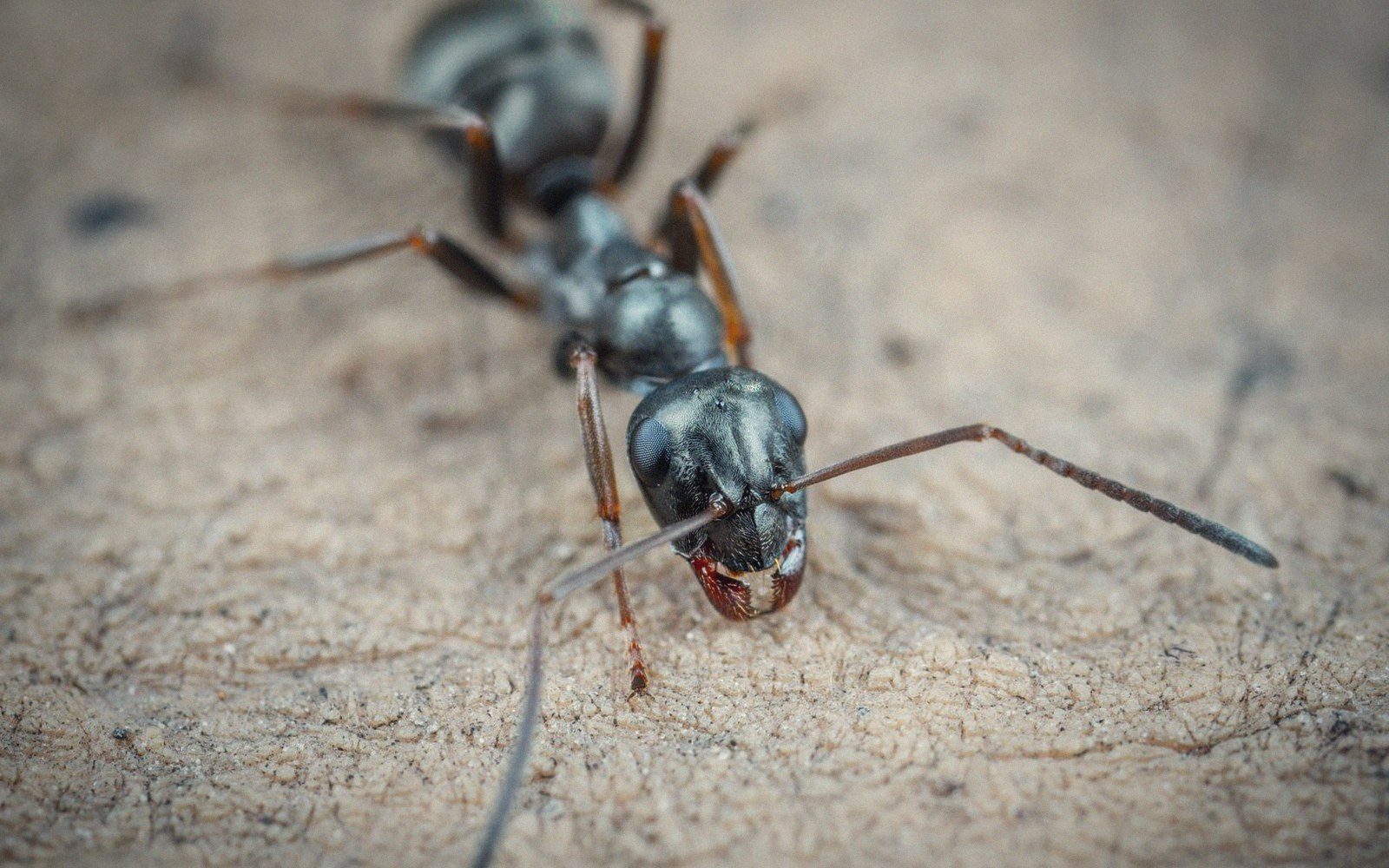
The scene is reliable enough to qualify as genre grammar: a scientist, soldier, or unlucky civilian absorbs a dose of radiation, and something changes. In Them! (1954) the change is scale — common Camponotus ants rewritten upward into monsters. In The Amazing Colossal Man (1957) it is Glen Manning's body that refuses to stop enlarging after a plutonium blast at the Nevada Test Site. In The Incredible Shrinking Man (1957), Scott Carey shrinks, which is at least a change in the opposite direction. In a hundred lesser pictures the effect is faster: a glowing wound, a convulsion, and then a compensatory strength or monstrous transformation. The premise in every case is that ionising radiation is a kind of instruction — that it tells living tissue to become something else, purposefully and coherently.
It does not do that. What it does is considerably less dramatic in its visual grammar and considerably more destructive in its results.
Key biological terms
Strip 1 / 2 · lifted from the reel
01
Ionising radiation — radiation energetic enough to strip electrons from atoms; the category includes X-rays, gamma rays, neutron particles, high-energy alpha and beta emissions
02
Strand break — physical disruption of the DNA double helix; the primary mechanism of radiation damage at the cellular level
03
Acute radiation syndrome (ARS) — the clinical condition produced by high-dose whole-body exposure; haematopoietic and gastrointestinal systems fail first
04
Haematopoietic failure — collapse of blood-cell production in the bone marrow; the main cause of death in moderate-to-high acute doses
05
Translocation — a chromosomal error in which a section of one chromosome is transferred to another; a classic product of misrepaired strand breaks
What the Radiation Actually Hits
Ionising radiation — X-rays, gamma rays, neutron flux, high-energy alpha and beta particles — damages living tissue at the molecular level by stripping electrons from atoms in its path. When that happens inside a cell, the primary target of consequence is deoxyribonucleic acid. The damage is not an edit; it is a break. Strand breaks, base oxidation, cross-linking between strands: the genome does not receive new information, it loses structural integrity in the affected region.
Cells have repair mechanisms, and at low doses most damage is corrected. At higher doses the repair either fails or introduces errors in the correction — misrejoined breaks, deletions, translocations. These errors, if they occur in a cell that survives and continues to replicate, produce daughter cells carrying corrupted genetic material. That is the clinical and biological definition of mutation: a heritable error of replication, not an upgrade. The error may be silent, it may be lethal to the cell, or it may confer a replicative advantage — which is the mechanism by which a population of damaged cells can, over years, become a tumour. Cancer is the canonical long-term radiation injury, not transformation.
Acute high-dose exposure does something different and more immediate. Rapidly dividing cell populations — bone marrow, gut epithelium, the lining of blood vessels — are hit hardest, because the more often a cell divides, the more often it must copy and deploy its DNA, and the more occasions radiation damage has to propagate. The clinical picture of acute radiation syndrome is therefore haematopoietic failure, gastrointestinal failure, fluid loss, infection from immune collapse. The body does not reorganise; it stops functioning in ways that depend on continuous cell replacement.
02
A projection lens, and the beam going out through the haze toward a screen you cannot see.Photo: Ann H / Pexels
What the Films Choose Instead
The Hollywood mutation sequence (how the genre convention maps onto real biology)
Strip 2 / 2 · lifted from the reel
01
Radiation as instruction — genre assumption: dose delivers coherent redesign signal to tissue
02
Radiation as noise — actual biology: dose introduces copying errors with no direction or intention
03
Transformation coherent, purposeful — genre outcome: a giant ant, a colossal man, a shrinking body
Dramatic utility — why the genre version persists: coherent monsters generate plot; epidemiology does not
The gap is one of dramatic utility. A man dying of sepsis from immune collapse is not a monster. A colony of ants enlarged to the size of horses can be shot at. Hollywood's mutation is goal-directed: the radiation acts like a sculptor, producing a coherent new form from the old one, as though the dose carried an aesthetic intention. This is the mechanism that Them! established as template — the blast doesn't kill; it redesigns — and the fifty pictures that followed it recycled the same premise because it generates story. Radiation-as-sculptor creates antagonists. Radiation-as-biology creates statistics.
The shrinking films are, in their strange way, almost more honest about the arbitrariness of the effect — though The Incredible Shrinking Man still imagines the dose as precise, targeting Scott Carey's cells for a uniform reduction in scale rather than killing him outright. What the film needs its physics to do and what the physics would do are two entirely different things. The filmmakers knew this; they didn't care, which is the honest answer.
The one consistent scientific truth embedded in the genre is negativity of outcome. Almost nothing the radiation does on screen is presented as neutral — transformation is always monstrous, enlargement always ends in military response, shrinkage always ends in existential crisis. In that sense the films are not wrong about the valence, only the mechanism. The error lies in imagining the damage as coherent, designed, productive of form. Real radiation injury is noise introduced into a copying process. What noise makes, given time, is not a monster: it is a cell population that replicates without control, or a body system that ceases to maintain itself. The cinema gave ionising radiation an agenda it does not possess, and the resulting visual grammar proved so durable that it is still the operating assumption of the genre seventy years on.