Frame 12 · After the Bomb · examined as evidence, not illustration
After the Bomb
Fallout as Weather: How the Sky Changed
Tracks the visual evolution of the post-apocalyptic sky across five decades of films — from the clear blue of On the Beach to the ash-grey perpetual overcast of later productions — as a measure of how the genre's assumptions about survivability shifted..
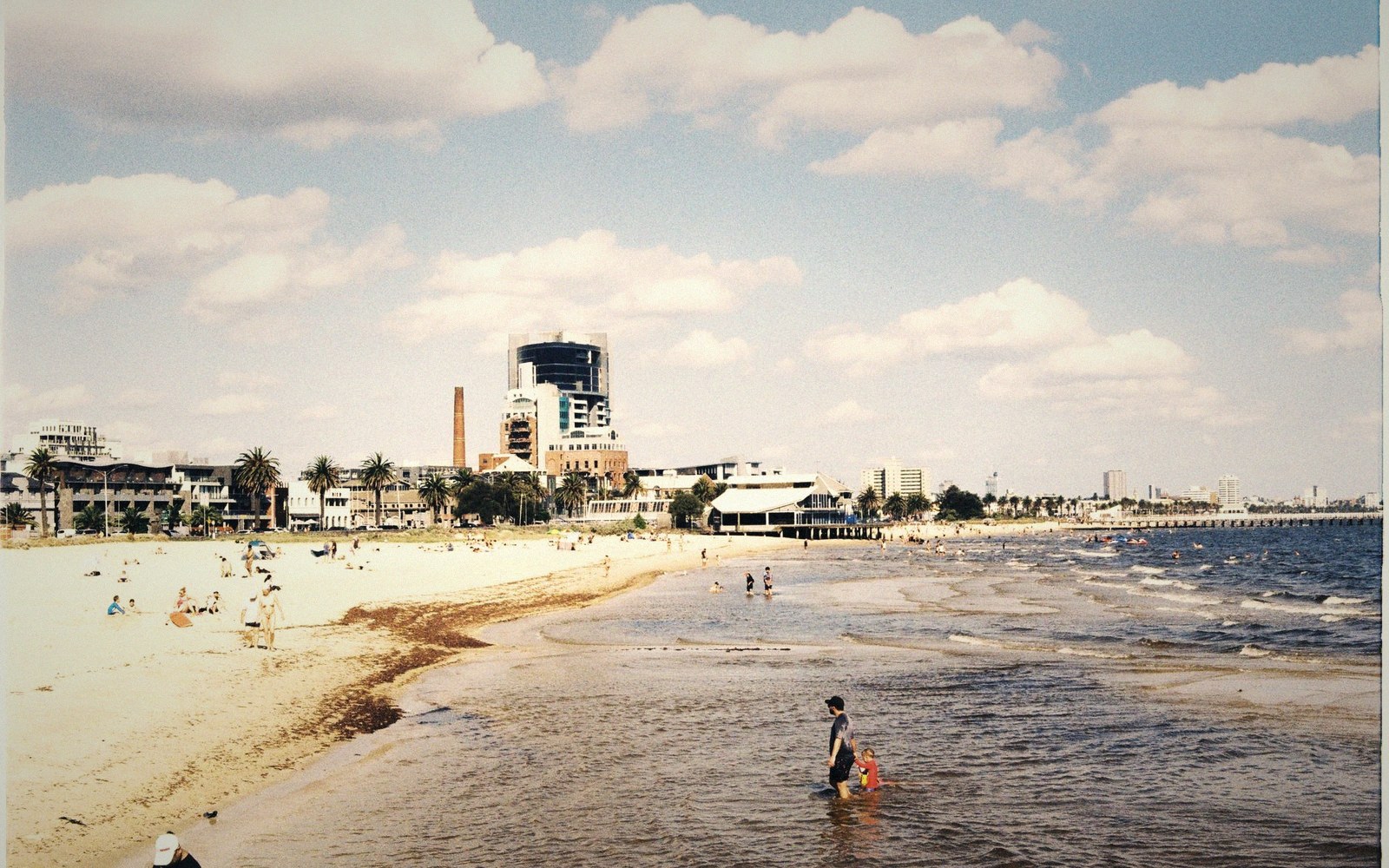
In Stanley Kramer's On the Beach (1959), the sky over Melbourne is clean. Sunlight falls on empty streets, laundry hangs still on lines, a Coca-Cola bottle swings from a window-blind cord. The visual grammar insists that the world is intact; only the people are gone. Radiation is invisible, odourless, arriving on the wind like a seasonal change. The horror depends entirely on the sky being normal.
That normalcy was not naivety — it was a specific mid-century assumption. Atmospheric nuclear tests were still routine in 1959. The public had been taught, partly through civil-defence films and partly through careful government messaging, that fallout was a manageable hazard: shelter for two weeks, then emerge into a recoverable world. The blue sky above Melbourne encodes that survivalism. Things will be bad. Things will not be permanent.
The visual shift in four frames
Strip 1 / 1 · lifted from the reel
01
On the Beach (1959) — clear daylight sky over depopulated Melbourne street
02
Early 1960s atomic-era productions — pale blue or washed-out overcast, minimal ash
03
Threads (1984) — heavy brown-grey noon sky, Sheffield exterior
04
The Road (2009) — near-lightless ash-fall exterior, no direct sun
The sky begins to close somewhere in the late 1970s. By the time the BBC's Threads arrives in 1984, Sheffield is buried under a brown-grey ceiling that barely lightens at noon. The shift is literal: nuclear winter theory, formulated in published scientific work in the early 1980s, had entered the cultural bloodstream. Soot and dust in the upper atmosphere, the modellers argued, would suppress sunlight for months or years. Threads registers this; its skies do not clear across its entire run.
02
A projection lens, and the beam going out through the haze toward a screen you cannot see.Photo: Ann H / Pexels
The later the film, the darker the ceiling tends to be. John Hillcoat's The Road (2009) operates under a sky that has apparently not shown direct sun in years — ash falls, fires glow without warmth, crops are gone. The overcast is not weather in the ordinary sense; it is the permanent condition of the world. Survivability is no longer the question the film asks.
Reading these skies as a sequence is more reliable than reading the dialogue. Directors can soften a screenplay's despair with a consoling ending; they cannot easily fake what the sky tells the audience about the physics. The arc from Kramer's Melbourne to Hillcoat's grey charnel road is, frame for frame, the arc of a culture revising its estimate of what nuclear war would actually leave behind — not a thinned-out world waiting to be repopulated, but a closed ceiling under which the concept of recovery no longer applies.