Frame 09 · After the Bomb · examined as evidence, not illustration
After the Bomb
Panic in Year Zero: Suburban Collapse
A walk-through of the 1962 AIP film sequence by sequence, charting how quickly its middle-class family discards its values — and arguing that this moral-collapse arc is more disturbing than any mushroom cloud the film shows..
The mushroom cloud is almost incidental. What lingers is the speed at which a Californian family becomes something else entirely.
The Freeway as Rubicon
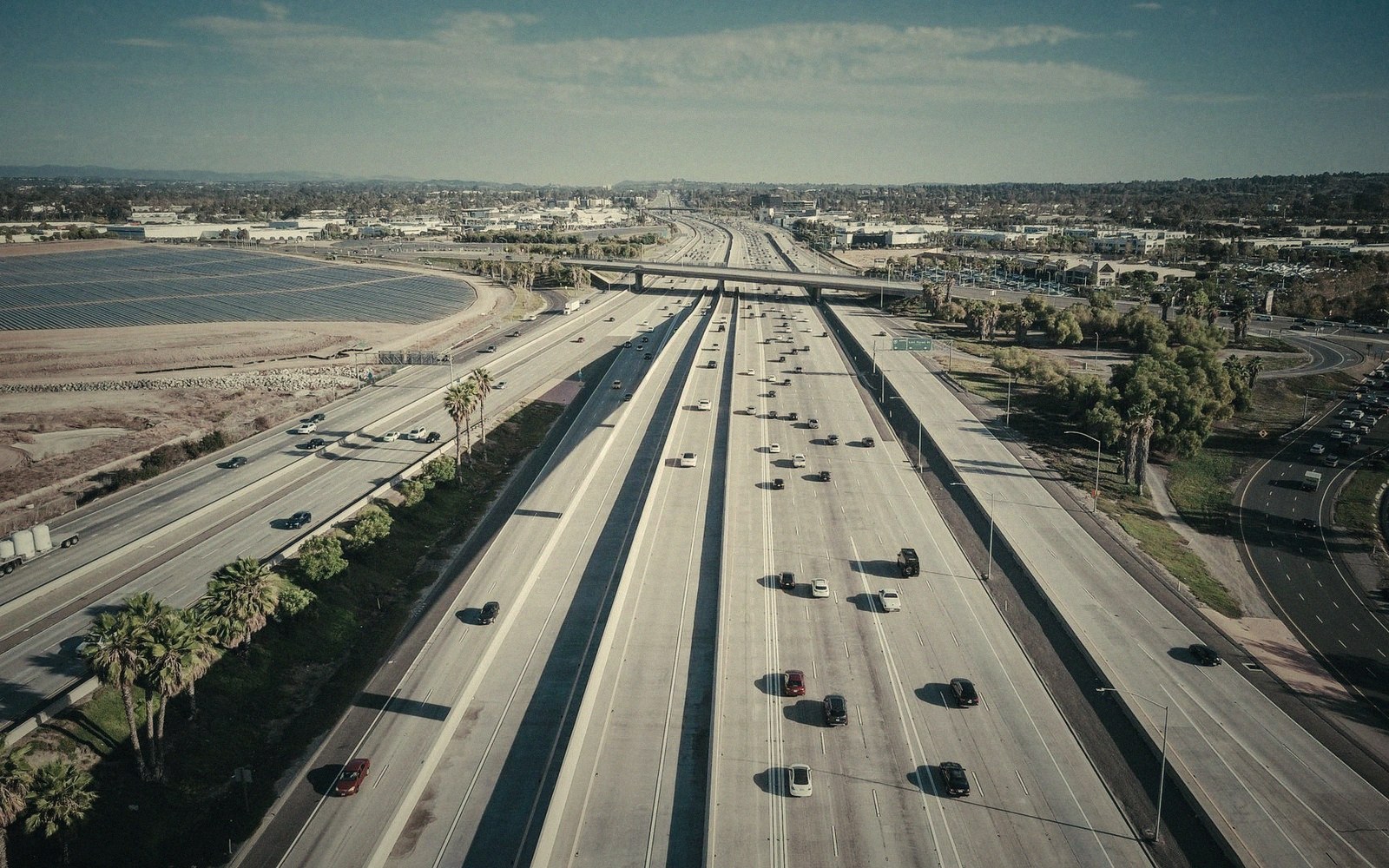
Ray Milland directs himself in American International Pictures' Panic in Year Zero! (1962), and the casting is the argument. Milland, by then a reliable face of postwar respectability — Oscar-weighted, silver-templed — plays Harry Baldwin, a Pasadena father loading a camper for a fishing weekend when the Los Angeles skyline ignites behind him. The mushroom clouds, glimpsed through the rear window in the first minutes, are rendered in stock footage, cheap and brief. Milland the director knows they are not the point. The point is the on-ramp.
What follows is a sequence that earns the film its reputation: Harry, watching the freeway thicken with panicked civilians, simply drives the wrong way up the exit ramp and leaves the gridlock behind. It takes him perhaps forty seconds to decide. His wife Ann (Jean Hagen) protests. His teenage son Rick (Frankie Avalon, working against teen-idol type with genuine unease) says nothing. Harry has already done the arithmetic. The film is barely fifteen minutes old, and the social contract is already in the ditch.
This is Panic in Year Zero!'s central mechanism. Not radiation, not fallout — though both are gestured at — but the rate of moral divestiture. Milland strips his protagonist of one value per sequence with the efficiency of a man packing only what he can carry: civic obligation first, then commercial honesty, then the presumption against violence. Each shedding arrives faster than the last, until by the film's midpoint Harry Baldwin is a man who pistol-whips a hardware-store owner and thinks of it as logistics.
The moral ledger
Strip 1 / 2 · lifted from the reel
01
Freeway on-ramp — Harry drives against traffic; civic obligation abandoned, approx. minute 15
02
Hofer's hardware store — coerced purchase at gunpoint; commercial honesty abandoned, approx. minute 35
03
The cave above San Gabriel Valley — family sealed off from any broader community; solidarity abandoned
04
The killing of the three assailants — violence normalised as logistics, approx. final third
05
Rick's independent act of violence — the lesson transmitted and exceeded; no authorial rebuke from the film
The Hardware Store and What It Costs
The scene in Hofer's hardware store is the film's moral crux, and it deserves to be watched slowly. Harry enters intending to buy supplies. The owner, sensing leverage, has already begun marking prices upward in the chaos. Harry negotiates briefly, then stops negotiating. He produces a gun and takes what he needs, leaving cash at a price he decides is fair. The film frames this as a reasonable transaction — Harry is not looting, the movie seems to argue; he is imposing rational pricing on a gouger.
The logic is exactly as troubling as it sounds. Milland the director lights the scene flatly, with none of the expressionist shadows that a more self-conscious production might deploy. The ordinariness of it is the horror. Harry moves through Hofer's like a man doing the weekly shop. His son watches and learns. This is the film's real subject: not what a bomb does to a city, but what a city does to a father who believes his family constitutes the only community still worth protecting.
AIP, working on a production budget that precluded any large-scale destruction photography, stumbled into something more unsettling than spectacle. The absence of visible apocalypse forces the drama inward. We see almost no ruined infrastructure — a few panning shots of deserted roads, a gas station owner shot in the background of a scene almost as an afterthought. The bomb is an excuse. The savagery is suburban.
02
A projection lens, and the beam going out through the haze toward a screen you cannot see.Photo: Ann H / Pexels
Sequence by Sequence, Value by Value
Production context
Strip 2 / 2 · lifted from the reel
01
Studio — American International Pictures, 1962
02
Director/star — Ray Milland (also produced)
03
Supporting cast — Jean Hagen, Frankie Avalon, Mary Mitchel
04
Budget constraint — no large-scale destruction photography; mushroom-cloud imagery from stock footage
05
Source — loosely adapted from Ward Moore's short stories "Lot" (1953) and "Lot's Daughter" (1954)
The film's structure is nearly schematic. Harry locks his family in a cave above the San Gabriel Valley. He forages, intimidates, and finally kills when three young men assault his daughter Karen (Mary Mitchel) — a sequence the film handles with restraint unusual for AIP, cutting away at the right moment and returning to consequences rather than act. Milland the director is better here than the script deserves. The killing itself is presented as clean necessity, which is its own kind of disturbance: by this point, the film has so thoroughly rehabilitated Harry's ruthlessness that the audience has been made complicit in endorsing it.
Rick's arc is the darker parallel. Avalon's performance is limited but serviceable, and the role asks only that he go from uncertain to coldly imitative — his father's lessons absorbed without his father's residual hesitation. When Rick ultimately acts with more violence than Harry has explicitly sanctioned, the film treats it as maturation. The suburban values the Baldwins carried out of Pasadena — neighbourliness, restraint, due process — have been fully metabolised into their opposite, and the movie cannot quite see that this is a tragedy.
The ending attempts to correct course. The Army arrives, order is notionally restored, and Harry delivers a speech about rebuilding that the script intends as redemptive. It does not work, and Milland the director is intelligent enough to have shot it with audible uncertainty: the words arrive, but the faces remember everything that preceded them. The man who drove the wrong way up the freeway on-ramp cannot be unknotted from the man now welcoming the authorities back. He is both, simultaneously, and the film is honest enough — if not quite brave enough — to let the contradiction stand.
What Panic in Year Zero! finally gives the nuclear-age cycle that most of its contemporaries withheld is a protagonist who is not a scientist, a soldier, or a bureaucrat. Harry Baldwin is a commuter with a fishing rod, and the film's quiet, persistent argument is that the commuter was always already capable of this — that the Pasadena lawn and the pistol-whipped hardware merchant were never as far apart as the lawn suggested.