Frame 13 · The Science They Got Wrong · examined as evidence, not illustration
The Science They Got Wrong
The Incredible Shrinking Man and the Inverse-Square Problem
Uses the 1957 Universal picture as a case study in what the film needs its physics to do — and why every actual implication of a man shrinking at that rate would end the film in reel two.
The 1957 Universal picture is one of the most intelligent science-fiction films of its decade. Its physics, on the other hand, would kill Scott Carey before the spider ever gets a chance.
What the Film Needs to Be True
Jack Arnold's The Incredible Shrinking Man (1957) earns its reputation. Richard Matheson's screenplay, adapted from his own novel, takes its premise seriously enough to follow Scott Carey's diminishment into genuine existential territory. The film's final monologue — Carey dissolving into the sub-atomic — remains one of Hollywood's more startling acts of ambition. None of which changes the fact that the physics required to keep Carey functional are, at every stage, quietly impossible.
The premise is clean: a radioactive mist, combined with insecticide exposure, triggers a process of continuous shrinking. Carey loses roughly an inch of height per week. What the film does not reckon with — cannot reckon with, because it would terminate the narrative — is the cascade of physical consequences that would accompany a reduction in linear scale at that rate.
The central problem is surface-area-to-volume ratio, and it is not subtle. Volume scales with the cube of linear dimension; surface area scales with the square. Halve a man's height and you reduce his volume to one-eighth while his surface area falls only to one-quarter. He is now, relative to his mass, twice as exposed to the environment as he was. The biological consequences arrive fast and are not cinematic. A man at one-quarter of normal height has a surface-area-to-volume ratio roughly four times that of a full-sized person. He loses heat catastrophically. He would need to eat continuously — several times his own body weight in calories each day — simply to maintain core temperature. Carey, subsisting on cracker fragments in a dolls' house, would be dead of hypothermia and caloric collapse within hours of entering the cellar.
The physics that break the premise
Strip 1 / 2 · lifted from the reel
01
Surface-area-to-volume ratio — volume drops as the cube of linear scale; surface area drops as the square; a shrunk body loses heat and requires proportionally more calories per unit mass
02
Acoustic pitch — a smaller resonating chamber produces higher frequency; Carey's voice should rise, not simply diminish
03
Radiation biology — ionising radiation causes cellular damage, not uniform size reduction; the mist is a cultural signifier, not a mechanism
What the Camera Does Instead
02
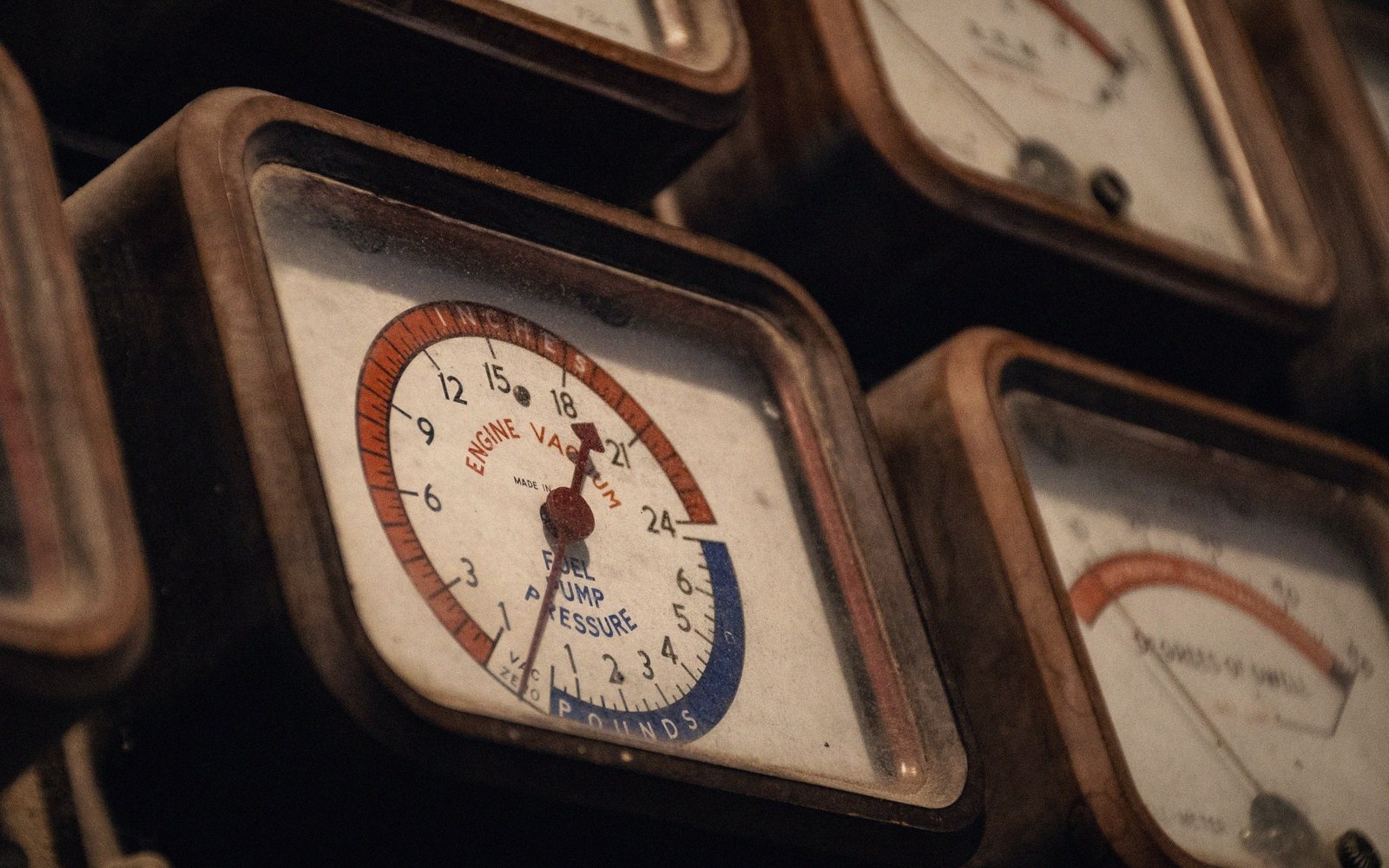
Dials under glass — the needle is the instrument this genre trusted to raise a pulse.Photo: Brett Sayles / Pexels
The film handles this with a technique common to the whole giant-creature cycle: it preserves the physics of drama while discarding the physics of matter. Carey remains warm, coherent and capable of sustained exertion. His voice stays at the same pitch rather than rising — a detail the film gets wrong, since a smaller resonating chamber would produce a higher frequency. These are not oversights so much as contracts with the audience: the film has decided which register of reality it is operating in, and it is not the one inhabited by thermodynamics.
Scale effects the film actually uses
Strip 2 / 2 · lifted from the reel
01
Relative structural strength — at small scale, cross-sectional muscle area is large relative to body mass; the pin-as-weapon is the film's most physically grounded conceit
02
Set design — the cellar sequence was built at deliberate over-scale; the exaggerated furniture implicitly dramatises the cube-square law even if the screenplay never names it
What the film actually engages, with some seriousness, is mechanics at changed scale. The famous set design — oversized furniture, a giant cotton-reel spool, a sewing needle repurposed as a weapon — does reflect a real principle: at small scale, relative strength improves. An ant can carry many times its own body weight because its muscles, cross-sectional area scaling with the square, are large relative to its mass. Carey wielding a pin against a cellar spider is, in this narrow respect, not entirely implausible. The film found the one domain of scale physics that works in its favour and built the third act around it. That is not dishonesty; it is selection.
The radiation angle is, as in most films of the period, decorative rather than functional. The mist is a trigger, not a mechanism. Ionising radiation does not cause progressive, uniform shrinkage — it damages DNA, disrupts cellular replication, and produces effects that are the opposite of cinematic tidiness. The film borrows the cultural charge of radiation fear without committing to its biology, which was standard practice in 1957 and is hardly a mark against the picture specifically.
What The Incredible Shrinking Man understood, and what saves it from the fate of lesser entries in the cycle, is that the physics were always instrumental. The shrinking is a premise in service of a moral argument about scale, insignificance and continuity. The science does not need to be right; it needs to be coherent enough not to pull the audience out of the argument. On those terms, the film holds. Just do not run the thermodynamics.