Frame 18 · Newsreel & Civil Defence · examined as evidence, not illustration
Newsreel & Civil Defence
Duck and Cover: The Film, Not the Drill
A close reading of the 1952 Federal Civil Defense Administration film as a work of graphic design and montage — its frame composition, its pacing, its musical choices — rather than as a cultural punchline..
Fifty years of mockery have obscured what the 1952 Federal Civil Defense Administration film actually does well.
Bert in the Frame
The standard account of Duck and Cover begins and ends with condescension: children hiding under desks as if wood and linoleum could stop a thermonuclear fireball. That reading is not wrong about the physics. It is wrong about the film. Set the cultural punchline aside for ten minutes and watch what Archer Productions actually made for the Federal Civil Defense Administration in 1952, and you find a piece of graphic design and montage that repays close attention — coherent in its visual logic, precise in its address to its audience, and more formally controlled than its reputation allows.
The opening title card is doing work before Bert the Turtle appears. The typography is clean, mid-century institutional sans-serif, white on black — the same graphic register as public-health and traffic-safety films of the period. There is no hysteria in the design. The choice is deliberate: if you open with alarm, you lose the nine-year-olds who are your primary audience. The animators understood this. Bert's world is warm and rounded, his walk an unhurried bounce. When the firecracker detonates, the design does not shift to expressionist distortion — it simply cuts to live action, establishing a visual grammar that says the cartoon and the real world operate by the same rules. That equivalence is the film's central rhetorical move, and it is achieved entirely through montage rhythm.
Key production facts
Strip 1 / 2 · lifted from the reel
01
Release year — 1952; produced by Archer Productions for the Federal Civil Defense Administration (FCDA)
02
Director — Anthony Rizzo
03
Composer — Milton DeLugg (the "Duck and Cover" jingle)
04
Primary audience — schoolchildren; distributed to classrooms nationally via the FCDA
The Cut That Does the Arguing
The live-action sequences are shot by a camera that stays low — child-height, predominantly. Adults appear mostly as legs, or as authoritative voices off-screen. The child's-eye framing is not accidental; it mirrors the classroom instruction films produced by Coronet and similar educational outfits throughout the late 1940s, whose conventions the FCDA was consciously borrowing. What sets Duck and Cover apart is its pacing in the duck-and-cover demonstrations themselves. The film cuts on physical action: the moment a child's head goes down, the edit lands. The effect is a percussive rhythm — posture triggers cut triggers posture — that encodes the reflex rather than explaining it. This is behaviourist pedagogy working through montage, and it works.
The musical score, by Milton DeLugg, deserves its own paragraph. The "Duck and Cover" song — performed in a jingle style that echoes the commercial radio of 1951–52 — has been mocked as cheery propaganda. But DeLugg's arrangement is strategically restrained: it never overwhelms the narration, it returns as a reprise rather than playing continuously, and its major-key simplicity is precisely calibrated to avoid the minor-key dread that would have undermined the message of procedural calm. The film is trying to install a response, not communicate a threat level. The music is part of that installation, not a contradiction of it.
Chronology
Strip 2 / 2 · lifted from the reel
01
August 1949 — Soviet atomic test, the strategic event that made the FCDA's entire civil-defence project both urgent and, by its own logic, already outpaced
02
1952 — Duck and Cover released and begins classroom distribution
03
1950s onward — film becomes a fixture of school-drill culture across the United States
02
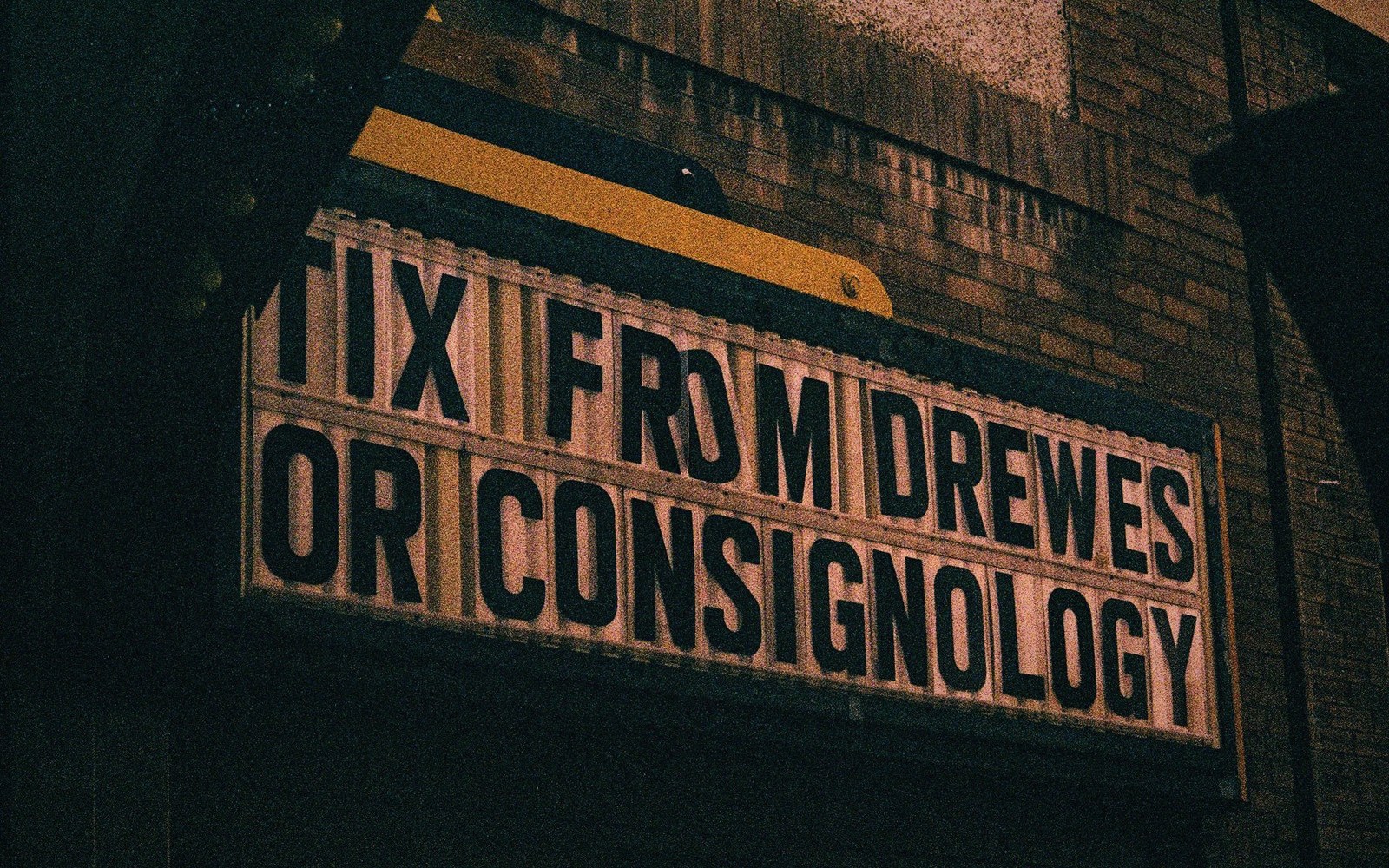
A lit letter-board at street level: the exhibitor’s half of the argument.Photo: David Guerrero / Pexels
What It Cannot Do
None of this defends the film's underlying premise. The physicists at the Atomic Energy Commission knew by 1952 that the Soviet test of August 1949 had opened a new strategic era, and that desktop cover offered negligible protection against a weapon's primary effects at meaningful distances. The FCDA's position — that civil preparedness was possible, trainable, and effective — was politically necessary in a way that outran the evidence. Duck and Cover is therefore an honest film in its craft and a dishonest one in its claims, and those two things exist simultaneously. Watching it only as a lie forfeits the chance to understand how institutional visual rhetoric actually functions: how a film disciplines its own tone, manages its audience's affect, and embeds behaviour through formal repetition.
The director, Anthony Rizzo, and his team at Archer Productions did not make a cynical product. They made a technically accomplished short film for an impossible brief — explain an unprecedented threat without inducing panic in an audience of young children. The impossibility is visible in every frame. So is the craft. The mockery came cheap. The looking took longer.